Hallelujah
I’d heard there was a secret chord
That David played and it pleased the Lord
But you don’t really care for music, do you?
Well, it goes like this
The fourth, the fifth, the minor fall, the major lift
The baffled king composing Hallelujah
Hallelujah, Hallelujah
Hallelujah, Hallelujah
Well, your faith was strong but you needed proof
You saw her bathing on the roof
Her beauty and the moonlight overthrew ya
She tied you to the kitchen chair
She broke your throne and she cut your hair
And from your lips, she drew the Hallelujah
Hallelujah, Hallelujah
Hallelujah, Hallelujah
Well baby, I’ve been here before
I’ve seen this room and I’ve walked this floor
I used to live alone before I knew ya
And I’ve seen your flag on the marble arch
And love is not a victory march
It’s a cold and it’s a broken Hallelujah
Hallelujah, Hallelujah
Hallelujah, Hallelujah
Well, maybe there’s a God above
But all I’ve ever learned from love
Was how to shoot somebody who outdrew ya
And it’s not a cry that you hear at night
It’s not somebody who’s seen the light
It’s a cold and it’s a broken Hallelujah
Hallelujah, Hallelujah
Hallelujah, Hallelujah
Hallelujah, Hallelujah
Hallelujah, Hallelujah
Hallelujah, Hallelujah
Hallelujah, Hallelujah

Listen to the song
Hør sangen

About the carol Hallelujah
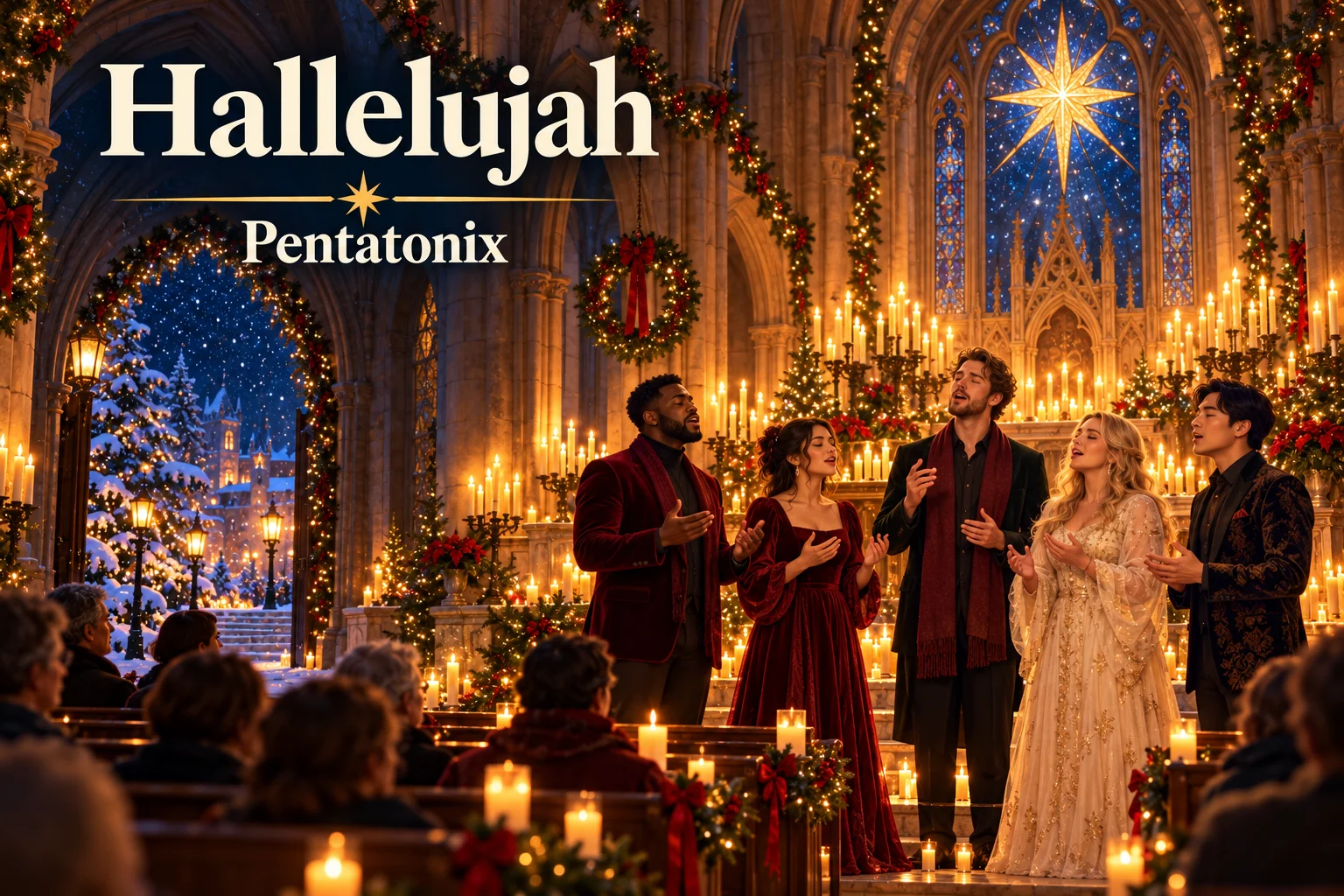
“Hallelujah” was written by Canadian singer-songwriter Leonard Cohen and first released in 1984. The song was not originally written as a Christmas carol, but its religious imagery and references to biblical figures have led many artists to include it in holiday performances. Pentatonix recorded their version for their Christmas album A Pentatonix Christmas, giving the song a prominent place in contemporary seasonal music.
The lyrics combine biblical references, romantic relationships and reflections on faith, doubt and human imperfection. The word “hallelujah” itself comes from Hebrew and can be understood as an expression of praise. Cohen’s original song contains many verses and themes, and different performers have selected or adapted verses for their own interpretations.
Pentatonix’s arrangement gives the song a distinctly Christmas-oriented atmosphere through layered a cappella vocals and a restrained, choir-like presentation. While “Hallelujah” is not inherently a Christmas song, its biblical language and Pentatonix’s holiday recording have made it strongly associated with the season for many listeners. Its connection to Christmas is therefore largely shaped by interpretation and performance rather than by the song’s original purpose.